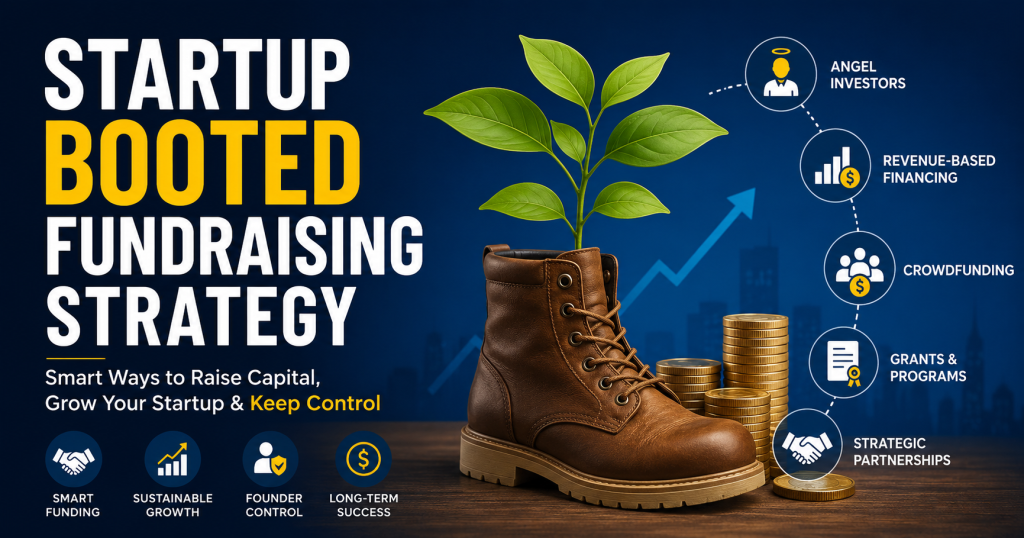
Starting a business is exciting, but raising money for growth can feel hard and confusing. Many founders today are searching for a smart startup booted fundraising strategy because they want to grow their company without losing full control. Instead of depending only on big investors, many startups now choose to build slowly, earn revenue early, and raise money carefully when needed.
A bootstrapped startup uses personal savings or business profits to grow. This method gives founders more freedom and ownership. But at some point, many businesses still need extra money for marketing, hiring, product development, or expansion. That is where a good fundraising strategy becomes important.
In this guide, you will learn how bootstrapped startups raise funds, what funding options work best, common mistakes to avoid, and how founders can grow their business in a smart and safe way.
Table of Contents
ToggleWhat Is a Bootstrapped Startup?
A bootstrapped startup is a business that starts and grows using the founder’s own money or the revenue the business earns. Instead of taking large investments from venture capital firms, the founder controls most decisions and ownership.
Many founders choose bootstrapping because they want freedom. They do not want pressure from outside investors. They also want to grow at their own speed.
Bootstrapping usually means:
- Starting with a small budget
- Keeping costs low
- Focusing on profit early
- Growing step by step
- Reinvesting earnings back into the business
Some of the world’s biggest companies started this way. Companies like Mailchimp and Basecamp became successful by focusing on sustainable growth instead of chasing fast investment money.
Bootstrapping is not always easy. Founders often work with limited resources. They may need to handle many tasks alone in the beginning. But this method teaches discipline and helps businesses become stronger over time.
Why Many Founders Prefer Bootstrapping Today
In the past, many startups believed venture capital was the only way to grow. Today, things are changing. More founders now understand that fast funding is not always the best option.
There are several reasons why founders prefer bootstrapping.
The first reason is ownership. When investors give money, they usually take equity in the company. This means founders lose some control. Bootstrapped founders keep more ownership and make decisions freely.
The second reason is flexibility. Investor-backed startups often face pressure to grow very fast. Sometimes this leads to risky decisions. Bootstrapped companies can grow more naturally and focus on long-term success.
Another reason is financial discipline. Bootstrapped businesses learn how to manage cash carefully. They focus on customers and profits instead of spending large amounts on unnecessary growth.
Many founders also want peace of mind. Running a company becomes stressful when investors expect fast results every few months. Bootstrapping reduces that pressure.
Because of these reasons, many modern startups now follow a hybrid approach. They bootstrap first and raise funds later only when necessary.
Can Bootstrapped Startups Raise Money?
Yes, absolutely.
Many people think bootstrapped startups never raise money, but that is not true. A business can bootstrap in the early stage and still raise funding later.
In fact, bootstrapped startups often become attractive to investors because they already prove they can survive and grow with limited resources. Investors like businesses that show:
- Real customers
- Revenue growth
- Low spending habits
- Strong founder commitment
- Healthy profit margins
A startup that earns money before fundraising usually has stronger negotiation power. Founders can ask for better deals because they are not desperate for cash.
Raising money after bootstrapping can help businesses:
- Hire better talent
- Increase marketing
- Improve technology
- Expand into new markets
- Speed up growth
The key is raising money at the right time and from the right sources.
Best Fundraising Strategies for Bootstrapped Startups
There is no single funding method that works for every startup. Smart founders choose the strategy that matches their business goals.
Here are some of the best fundraising options for bootstrapped startups.
Revenue-Based Financing
Revenue-based financing is becoming popular among modern startups. In this model, investors provide money in exchange for a percentage of future revenue.
This option works well for businesses with stable monthly income.
The biggest advantage is that founders usually keep more ownership compared to traditional venture capital. Payments also adjust based on revenue, which makes the system more flexible during slow months.
Many SaaS companies and online businesses prefer this funding method because it supports steady growth without heavy pressure.
Angel Investors
Angel investors are individuals who invest their personal money into startups. Many angel investors also provide guidance, mentorship, and business connections.
For bootstrapped founders, angel investors can be helpful because they often invest earlier than venture capital firms.
A good angel investor understands startup challenges and supports long-term growth instead of demanding fast returns immediately.
However, founders should still review agreements carefully before giving away equity.
Crowdfunding
Crowdfunding allows startups to raise money from the public through online platforms.
This method works especially well for creative products, gadgets, apps, and community-focused businesses.
Crowdfunding offers several benefits:
- Raises capital
- Tests market demand
- Builds early customers
- Creates brand awareness
Successful crowdfunding campaigns usually include:
- A clear product idea
- Simple messaging
- Strong visuals
- Honest storytelling
Many startups use crowdfunding as both a fundraising and marketing strategy.
Startup Grants
Startup grants are funds provided by governments, organizations, or business programs. Unlike loans, grants usually do not need repayment.
This makes grants one of the safest funding options for bootstrapped startups.
Grants are often available for:
- Technology startups
- Women founders
- Social impact businesses
- Education companies
- Healthcare startups
The application process can take time, but receiving grant funding helps startups grow without losing ownership.
Strategic Partnerships
Some startups raise money through partnerships with larger companies.
For example, a software startup may partner with a bigger company that wants access to new technology or services.
Strategic partnerships can provide:
- Funding
- Distribution channels
- Customers
- Industry expertise
- Brand trust
This strategy works best when both companies benefit from the relationship.
Venture Debt
Venture debt is a loan designed for startups. Unlike traditional bank loans, venture debt companies understand startup risks better.
This funding option helps startups access cash without giving away large amounts of equity.
However, founders must ensure they can repay the loan responsibly. Taking too much debt can create financial pressure later.
How to Prepare Your Startup for Fundraising
Before asking for money, founders must prepare carefully. Investors want proof that the business has real potential.
Preparation improves trust and increases the chances of getting funding.
Build Strong Revenue Numbers
Revenue is one of the most important signals for investors.
Even small but steady growth shows that customers value the product or service.
Investors usually look for:
- Monthly recurring revenue
- Customer growth
- Retention rates
- Profit margins
- Low customer acquisition costs
A startup with clear revenue trends appears more reliable and less risky.
Create a Clear Pitch Deck
A pitch deck is a short presentation that explains the startup.
A good pitch deck should include:
- The problem
- The solution
- Market opportunity
- Revenue model
- Growth numbers
- Business goals
- Funding needs
Founders should keep the message simple and easy to understand.
Complicated presentations often confuse investors instead of impressing them.
Understand Your Financials
Many startups fail because founders do not understand their numbers.
Before fundraising, founders should know:
- Monthly expenses
- Profit margins
- Cash flow
- Burn rate
- Customer acquisition costs
Strong financial understanding builds investor confidence.
Show Real Customer Demand
Investors care about real users more than ideas.
Even a small group of loyal customers can prove market demand.
Founders should collect:
- Testimonials
- User reviews
- Case studies
- Growth data
- Customer feedback
Real-world traction matters more than promises.
Common Mistakes Bootstrapped Founders Make
Many founders make avoidable mistakes while raising money.
Understanding these mistakes can save time and protect the business.
Raising Money Too Early
Some startups seek investment before validating their idea.
Without customers or revenue, founders often accept poor deals because they have little leverage.
It is usually better to build traction first before fundraising.
Giving Away Too Much Equity
Equity is valuable. Once founders give it away, getting it back is almost impossible.
Some startups lose control because they raise money too quickly from multiple investors.
Smart founders protect ownership carefully.
Ignoring Cash Flow
Revenue alone does not guarantee survival.
A startup can make sales and still fail if expenses are poorly managed.
Cash flow management is critical for every bootstrapped business.
Scaling Too Fast
Fast growth sounds exciting, but uncontrolled growth can destroy a startup.
Hiring too quickly, spending heavily on ads, or expanding too early can create financial problems.
Sustainable growth usually wins over reckless expansion.
Bootstrapping vs Venture Capital
Both bootstrapping and venture capital have advantages and disadvantages.
Bootstrapping gives founders:
- More ownership
- Better control
- Financial discipline
- Long-term flexibility
Venture capital provides:
- Faster scaling
- Large funding amounts
- Investor networks
- Faster hiring opportunities
The best option depends on the founder’s goals.
If the goal is rapid global expansion, venture capital may help.
If the goal is profitability, independence, and stable growth, bootstrapping may work better.
Many successful startups combine both approaches. They bootstrap early and raise funding later when the business becomes stronger.
Real Examples of Smart Bootstrapped Companies
Many famous companies started small and grew carefully before taking outside funding.
Mailchimp started as a side project and became one of the biggest email marketing platforms in the world without early venture capital funding.
Basecamp focused on profitability and slow growth instead of chasing investors. The company became known for its sustainable business model.
Zapier also followed a lean startup path in the beginning. The company concentrated on solving customer problems and building recurring revenue.
Shopify began with a small business idea and eventually grew into a global e-commerce platform.
These companies prove that startups do not always need massive funding to succeed.
How Founders Can Build a Sustainable Startup
Building a sustainable startup requires patience and smart decision-making.
Founders should focus on:
- Solving real customer problems
- Managing money carefully
- Growing step by step
- Building loyal customer relationships
- Improving products continuously
A business that earns customer trust has a much better chance of long-term success.
Founders should also avoid comparing themselves to heavily funded startups. Every business grows differently.
Steady progress often creates stronger companies than fast but unstable growth.
The Future of Bootstrapped Startup Funding
The startup world is changing quickly.
Today, founders have more funding choices than ever before. They no longer need to depend only on traditional venture capital.
New funding models like:
- Revenue-based financing
- Crowdfunding
- Online investor communities
- Creator-led investing
- Startup grants
are making entrepreneurship more accessible.
This change allows founders to build businesses on their own terms.
The future will likely bring even more flexible funding options for startups that value independence and profitability.
Final Thoughts
Choosing the right startup booted fundraising strategy can shape the future of a business. Bootstrapping gives founders freedom, discipline, and ownership, while smart fundraising provides resources for growth.
The key is balance.
Founders should avoid rushing into investment decisions. Instead, they should build strong products, earn customer trust, and understand their finances before raising money.
A successful startup is not always the one that raises the most funding. Often, it is the one that survives, grows steadily, and creates real value for customers.
With the right strategy, bootstrapped startups can grow into powerful and profitable companies without losing their vision.
Read more Interesting and informational Blogs Visit Our Website Lidarmos
Frequently-Asked Questions (FAQs)
What is a bootstrapped startup?
A bootstrapped startup is a business that grows using personal savings or company revenue instead of relying heavily on outside investors.
Can a bootstrapped startup still raise funding?
Yes. Many bootstrapped startups raise money later after building revenue, customers, and market traction.
What is the best fundraising option for bootstrapped startups?
The best option depends on the business model. Popular choices include angel investors, revenue-based financing, crowdfunding, and startup grants.
Why do founders prefer bootstrapping?
Founders prefer bootstrapping because it gives them more control, ownership, flexibility, and freedom to grow at their own pace.
Is bootstrapping better than venture capital?
Neither option is perfect for everyone. Bootstrapping works well for sustainable growth, while venture capital helps startups scale faster. The right choice depends on business goals.