
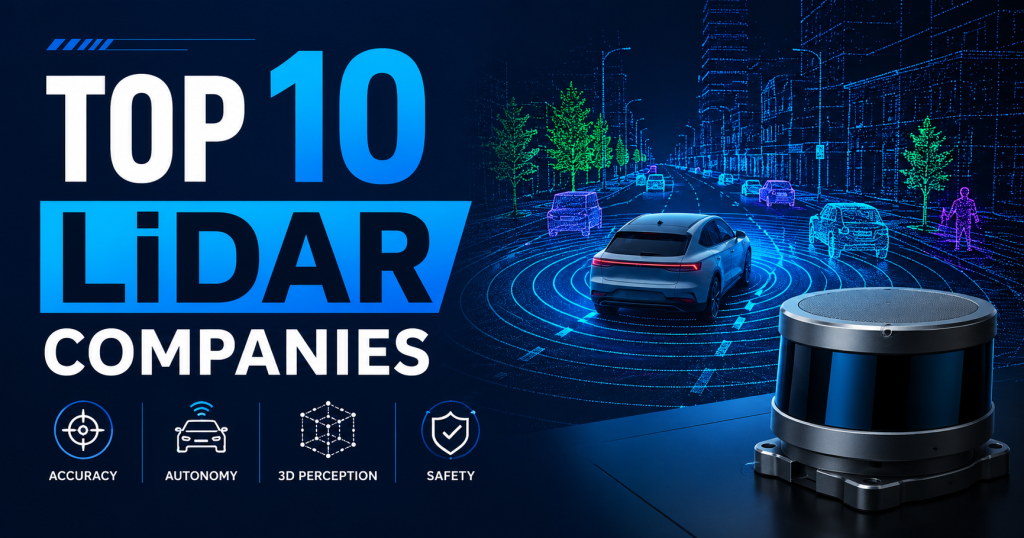
When people search for the best LiDAR brands, they usually want one simple thing: which companies actually make good LiDAR sensors, what do those sensors cost, and where are they used. That’s exactly what this guide covers.
I have been following the LiDAR industry for a while, and one thing I have noticed is that this market changes fast. Companies merge, some go bankrupt and come back under new names, and prices drop almost every year as the technology matures. So this list is built to reflect where things actually stand in 2026 — not where they were in 2021 when everyone was hyping LiDAR stocks.
LiDAR (Light Detection and Ranging) is the sensor technology that fires laser pulses and measures how long they take to bounce back. That data builds a 3D map of the world around the sensor. It is the backbone of self-driving cars, robot vacuums, drones, warehouse robots, land surveying, and even some smartphones.
Below are the top LiDAR companies worth knowing in 2026, what they sell, roughly what it costs, and who actually buys it.
Table of Contents
ToggleWhat Is LiDAR and Why Does It Matter in 2026
Before jumping into the company list, it helps to understand why LiDAR is suddenly everywhere — from cars to farms to construction sites.
Related Article: What is LiDAR? A Simple Beginner’s Guide (2026)
How LiDAR Sensors Actually Work
A LiDAR sensor sends out thousands of laser pulses every second. Each pulse hits an object and bounces back. The sensor measures the time it took for that round trip, and since light travels at a known speed, it can calculate the exact distance to that point. Do this thousands of times per second while spinning or scanning, and you get a “point cloud” — basically a 3D dot-to-dot picture of everything around the sensor.
Related Article: How Does LiDAR Work? Step-by-Step Explained
Why LiDAR Is Booming Right Now
The interesting thing about LiDAR in 2026 is that prices have crashed compared to five years ago. A sensor that cost $75,000 in 2016 can now cost under $1,000 for basic models. This price drop is mainly because Chinese manufacturers like Hesai and RoboSense built huge factories and brought costs down through scale, forcing everyone else to compete on price. Chinese companies now account for roughly 60% of automotive LiDAR revenues, with Hesai alone capturing a large share of the market on its own.
Where LiDAR Is Used Today
LiDAR is no longer just a “self-driving car” technology. In my experience researching this space, the real growth in 2026 is coming from warehouse robots, agricultural drones, mining trucks, smart traffic systems, and security perimeter monitoring. Cars get the headlines, but industrial and robotics use cases are quietly becoming the bigger market.
Top 10 LiDAR Companies in 2026 (Quick Overview Table)
Here is the full comparison table before we go into detail on each company.
| Company | Country | Top Product | Price Range (USD) | Main Use Case |
|---|---|---|---|---|
| Hesai | China | Pandar/ATX series, ETX | $200 – $5,000 | Autonomous cars, robotaxis |
| Ouster (incl. former Velodyne) | USA | OS1, OS2, REV8 | $2,500 – $18,000 | Industrial, robotics, defense |
| Luminar | USA | Halo / Iris | $500 – $1,500 (OEM volume) | Automotive ADAS, trucks |
| Innoviz | Israel | InnovizOne, InnovizTwo | $500 – $1,000 (OEM volume) | Automotive Level 2-3 driving |
| SICK AG | Germany | TiM, MRS series | $1,000 – $8,000 | Industrial automation, safety |
| Leica Geosystems | Switzerland | BLK series, RTC360 | $15,000 – $60,000 | Surveying, 3D mapping |
| Trimble | USA | MX series, X7 | $20,000 – $100,000+ | Geospatial, construction surveying |
| Quanergy Solutions | USA | M-Series | $3,000 – $10,000 | Security, smart infrastructure |
| Blickfeld | Germany | Cube 1, Cube Range | $1,500 – $6,000 | Smart city, traffic monitoring |
| RoboSense (bonus) | China | E1, M1, EM4 | $150 – $3,000 | Automotive, robotics |
Note: Prices are approximate retail or OEM list prices and vary a lot by volume, region, and configuration. Always check directly with the manufacturer for current quotes.
Detailed Breakdown of Each LiDAR Company
Now let’s go company by company so you understand what each one is actually good at.
Hesai Technology
Hesai is a Chinese company and, as of 2026, it is the single biggest name in automotive LiDAR by volume. Hesai captured roughly 37% of global automotive LiDAR market share on close to 200,000 units shipped in just one quarter of 2025, which tells you how dominant they have become.
- Top product: Pandar series for robotaxis and the newer ETX line for passenger cars
- Price range: Roughly $200 for basic short-range units up to $5,000 for high-end long-range models
- Main use case: Robotaxis, passenger car ADAS, and increasingly robotics
In January 2026, Hesai was selected as the LiDAR partner for NVIDIA DRIVE Hyperion 10, supplying automotive LiDAR to support Level 3 and Level 4 vehicle architectures, which is a strong signal of where their reputation stands. One thing worth knowing: in the US, regulatory restrictions have started limiting Hesai’s access to federal and defense contracts, so American buyers in those sectors usually look elsewhere.
Ouster (and What Happened to Velodyne)
This is something a lot of people get confused about, so let me clear it up. Velodyne, the company that basically invented spinning automotive LiDAR, merged with Ouster in 2023. They no longer exist as a separate company — Velodyne’s technology and product lines are now part of Ouster’s portfolio.
- Top product: OS1 (mid-range), OS2 (long-range), and the newer REV8 family
- Price range: Around $2,500 for entry-level OS1 units, scaling up to $18,000+ for high-resolution, automotive-grade configurations
- Main use case: Industrial automation, robotics, defense, and smart infrastructure
Ouster has positioned itself away from passenger-car automotive and more toward industrial and government use. Ouster’s OS1 LiDAR sensor received Department of Defense certification, which has become a real competitive advantage as US regulations push Chinese LiDAR out of federal procurement.
Luminar Technologies
Luminar has always positioned itself as the “premium, long-range” LiDAR brand, betting that performance — not price — is what wins automotive contracts.
- Top product: Halo (next-gen) and Iris platforms
- Price range: In OEM volume deals, per-unit cost is roughly $500 to $1,500; standalone units for developers can run higher
- Main use case: Automotive ADAS and highway-speed autonomous driving, plus trucking
Luminar restructured to trim $50–65 million in annual costs while doubling down on its Halo 1550 nm long-range platform and perception software, betting that premium performance will command margins where price competition is unsustainable. In my experience following this sector, Luminar is the company to watch if you care about long-range detection quality over raw price.
Innoviz Technologies
Innoviz is an Israeli company that focuses almost entirely on automotive partnerships rather than selling sensors broadly to developers.
- Top product: InnovizOne and InnovizTwo
- Price range: Roughly $500 to $1,000 per unit at OEM scale
- Main use case: Level 2+ and Level 3 driver-assist systems for car manufacturers
Innoviz’s biggest strength is its automotive qualification — getting a sensor certified to survive years of heat, vibration, and weather inside a production car is genuinely hard, and Innoviz has done it with multiple carmakers. The risk for Innoviz is that it depends heavily on a small number of automotive customers, so any delay from one OEM hits them hard.
SICK AG
SICK is a German industrial sensor giant, and LiDAR is just one part of a much bigger safety and automation business.
- Top product: TiM series (compact 2D LiDAR) and MRS series (3D multi-layer LiDAR)
- Price range: Roughly $1,000 for basic 2D units to $8,000 for multi-layer safety-rated sensors
- Main use case: Factory automation, safety zones around machinery, warehouse robots
If you work in manufacturing or logistics, you have probably seen SICK sensors without realizing it — they’re built into safety light curtains and collision-avoidance systems on forklifts and AGVs (automated guided vehicles).
Leica Geosystems
Leica is a name surveyors and mapping professionals already trust deeply, going back decades before “LiDAR” was even a buzzword.
- Top product: BLK series (compact handheld and mobile scanners) and RTC360 (high-speed reality capture)
- Price range: $15,000 to $60,000+ depending on resolution and range
- Main use case: Land surveying, construction documentation, heritage and 3D building scans
Leica’s sensors are not built for cars at all. They’re built for someone walking around a construction site or a historic building, capturing every millimeter for a 3D model. The price reflects extreme precision rather than mass production.
Trimble
Trimble is Leica’s main rival in the surveying and geospatial world, and the two often get compared directly by professionals shopping for mapping equipment.
- Top product: MX mobile mapping systems and the X7 3D laser scanner
- Price range: $20,000 to over $100,000 for full mobile mapping rigs
- Main use case: Geospatial surveying, infrastructure mapping, agriculture, construction
Trimble’s strength is integration — their LiDAR units usually come bundled with GPS positioning and software, so the output isn’t just a point cloud but a fully geo-referenced 3D map ready for engineering use.
Quanergy Solutions
Quanergy has an unusual story worth knowing before you consider them. The original publicly traded Quanergy Systems filed for Chapter 11 bankruptcy in December 2022 after burning through cash following its SPAC merger. The company’s assets were later restructured and the business re-emerged privately as Quanergy Solutions, now focused on niche markets instead of trying to compete broadly in automotive.
- Top product: M-Series solid-state LiDAR
- Price range: Roughly $3,000 to $10,000
- Main use case: Security perimeter monitoring, smart city sensing, industrial automation
I’m including Quanergy here because they are still active and shipping product, but if you’re evaluating them for a long-term project, it’s worth asking directly about their current financial stability and support roadmap given their history.
Blickfeld
Blickfeld is a smaller German company that has carved out a specific niche: affordable solid-state LiDAR for smart infrastructure rather than cars.
- Top product: Cube 1 and Cube Range
- Price range: Roughly $1,500 to $6,000
- Main use case: Smart city traffic monitoring, pedestrian counting, perimeter security
Blickfeld doesn’t try to compete with Hesai or Ouster on automotive volume. Instead, they target city governments and infrastructure operators who want to count vehicles, monitor intersections, or detect intrusions without using cameras (which raises privacy concerns LiDAR mostly avoids since it doesn’t capture faces or license plates in detail).
RoboSense (Honorary Mention)
I’m adding RoboSense as a bonus entry because, honestly, leaving it off a 2026 list would be misleading — it’s now one of the two biggest LiDAR makers in the world alongside Hesai.
- Top product: E1, M1 (short-range, often built into car bumpers), and the newer EM4 platform
- Price range: As low as $150 for compact short-range units to around $3,000 for higher-end models
- Main use case: Automotive ADAS, robotics
RoboSense launched its Phoenix and Peacock chipsets in April 2026, based on a new SPAD SoC architecture that brings image-grade 3D perception to improve sensing performance for next-generation intelligent driving systems. Along with Hesai, RoboSense and a small group of Chinese suppliers now collectively account for more than 90% of the entire automotive LiDAR market, which is a huge shift from just a few years ago when American and Israeli companies led the space.
How to Choose the Right LiDAR Company for Your Project
If you’re trying to actually buy a LiDAR sensor rather than just read about the industry, here’s how I’d think about it.
For Automotive and Self-Driving Projects
If you’re building or testing autonomous vehicle software, Hesai and RoboSense offer the best price-to-performance ratio right now, but US-based buyers in defense or government-adjacent work should look at Ouster or Luminar due to import restrictions on Chinese sensors in sensitive sectors.
For Surveying, Mapping, or Construction
Leica and Trimble are the obvious choices here. They cost more, but the precision and the software ecosystem around them (point cloud processing, CAD integration, GPS tagging) make the higher price worth it for professional survey work.
For Robotics, Warehouses, and Industrial Safety
SICK and Ouster dominate this space because their sensors are rated for industrial safety standards and built to survive rough factory environments — vibration, dust, temperature swings — that automotive-grade sensors aren’t always designed for.
Frequently Asked Questions
What is the cheapest LiDAR sensor you can buy in 2026?
Short-range solid-state units from Chinese manufacturers like RoboSense and Hesai can cost as little as $150 to $300 at high volume. For a single unit bought by an individual developer, expect closer to $1,000 to $2,500 for entry-level models from most brands.
Is Velodyne still a separate LiDAR company?
No. Velodyne merged with Ouster in 2023 and now operates as part of Ouster’s combined product lineup rather than as an independent company.
Which LiDAR company is best for self-driving cars?
It depends on your region and budget. Hesai and RoboSense lead on price and volume globally, while Luminar and Innoviz are stronger choices for Western automakers wanting long-term OEM partnerships outside Chinese supply chains.
What is the difference between LiDAR and radar?
LiDAR uses laser light to build a detailed 3D point cloud and is excellent at detecting exact shapes and distances. Radar uses radio waves, works better in fog and heavy rain, but gives a much lower-resolution picture. Most self-driving systems use both together.
Do I need a license or certification to buy LiDAR sensors?
Generally no for most commercial and research use, though some high-power automotive-grade sensors have export restrictions depending on your country. Always check local import rules, especially if buying from overseas manufacturers.
Conclusion
The LiDAR industry in 2026 looks very different from how it looked even three or four years ago. Velodyne is gone as an independent brand, Quanergy went through bankruptcy and came back smaller, and Chinese manufacturers like Hesai and RoboSense now dominate the automotive segment on pure scale and pricing. Meanwhile, Western companies like Luminar, Innoviz, and Ouster have shifted toward premium performance, defense contracts, and industrial niches where they can compete on quality rather than price alone.
If there’s one thing I’d want you to take away from this guide, it’s this: don’t pick a LiDAR company just because it’s the most famous name. Match the company to your actual use case — automotive, surveying, robotics, or smart infrastructure — and the price range that fits your project. The “best” LiDAR brand really depends on what you’re building.

Technology writer and researcher passionate about LiDAR, robotics, and AI systems. Through Lidarmos, I share in-depth guides and insights to make cutting-edge sensing technology accessible to everyone.

