
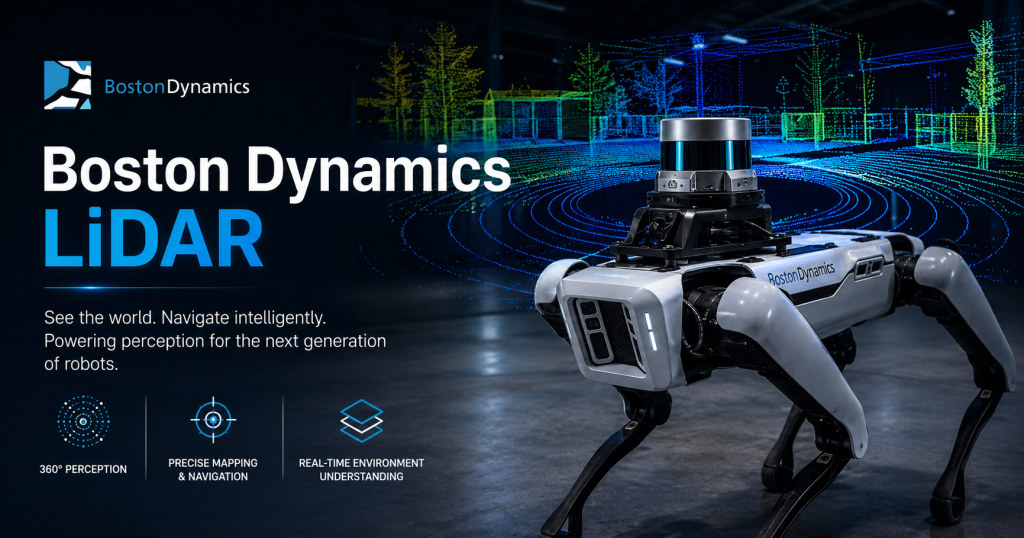
2026 has turned out to be the year humanoid robots stopped being a CES novelty and started clocking actual shifts on factory floors. Boston Dynamics’ Atlas is sequencing car parts at Hyundai’s Georgia plant, Figure AI’s Figure 03 is folding laundry in pilot homes, and Tesla’s Optimus is quietly learning tasks inside Tesla’s own factories. But behind all the headlines about dexterity and AI brains, there’s a quieter, more technical debate going on: should a humanoid robot “see” the world with lasers (LiDAR), cameras, or both?
This guide breaks down exactly how humanoid robots use LiDAR — and why some of the biggest names in robotics, like Tesla, have deliberately chosen to skip it. We’ll go company by company (Boston Dynamics, Figure AI, Tesla Optimus, Agility Robotics, Unitree, and Apptronik), look at the Boston Dynamics LiDAR setup in detail, and round things off with the latest 2026 sensor and supply-chain developments from LiDAR makers like Hesai, RoboSense, and Livox.
What Is LiDAR and Why Does It Matter for Humanoid Robots?
LiDAR stands for Light Detection and Ranging. Instead of passively capturing light like a camera does, a LiDAR unit actively fires out pulses of laser light and measures how long it takes for them to bounce back. That timing data gets turned into a “point cloud” — basically a 3D map of everything around the sensor, accurate to within a few centimeters.
Related Article: What is LiDAR? A Simple Beginner’s Guide (2026)
How LiDAR Works in Robotics
For a humanoid robot, this matters because walking on two legs through cluttered, unpredictable spaces (a warehouse aisle, a factory floor, someone’s living room) is fundamentally a 3D problem. A robot needs to know not just “is there an object in front of me” but exactly how tall a step is, how wide a doorway is, and where the edge of a pallet sits in space. LiDAR is particularly good at this because, unlike cameras, it doesn’t get confused by low light, glare, or a lack of visual texture (think: a plain white wall).
Related Article: How Does LiDAR Work? Step-by-Step Explained
LiDAR vs Cameras vs Depth Sensors
Most humanoid robots don’t rely on just one sensor type — they combine several:
- LiDAR — best for precise distance and shape measurement, works in poor lighting
- Stereo/RGB cameras — best for recognizing what an object actually is (a cup vs. a wrench)
- Depth (ToF) cameras — shorter-range 3D sensing, often used for close-up manipulation
- IMUs (inertial measurement units) — track balance and orientation, not the environment
The interesting thing about 2026’s humanoid robot designs is that the industry has split into two camps: companies that fuse LiDAR with cameras for redundancy, and companies (most notably Tesla) that have bet everything on cameras alone.
Related Article: LiDAR vs Radar vs Camera: Which is Better for Self-Driving Cars?
How Boston Dynamics’ Atlas Uses LiDAR
Atlas’s Sensor Suite
Boston Dynamics has used LiDAR in its Atlas humanoid robots for years, going back to the older hydraulic versions that combined a spinning LiDAR unit with stereo cameras in the head for navigation and terrain assessment. The current, fully electric Atlas — the version Boston Dynamics describes as its first true product release — keeps that philosophy. According to the robot’s published specifications, Atlas integrates LiDAR alongside stereo and RGB cameras and depth sensors, giving it real-time environmental awareness for tasks like packing, sorting, and adapting to unexpected obstacles on the move.
CES 2026 and the Hyundai Deployment
This isn’t theoretical anymore. At CES 2026, Boston Dynamics gave Atlas its first public demonstration, walking, waving, and spinning on stage before unveiling the production-ready version built specifically for Hyundai’s automotive plants. By January 19, 2026, fleets of electric Atlas units had already started working at the Hyundai Motor Group Metaplant America (HMGMA) in Georgia — reportedly the first time general-purpose humanoid robots have been deployed for complex material handling in a high-volume auto plant. Boston Dynamics LiDAR-equipped Atlas units there can sequence parts and arrange components weighing up to 50 kg, working in “fenceless” zones alongside human staff rather than behind safety cages.
Why Atlas Needs LiDAR for Heavy Industrial Work
I think this is the part that often gets overlooked in the Tesla-vs-everyone debate: Atlas isn’t being built for a tidy, predictable home environment — it’s working in active manufacturing cells where part bins move, lighting changes shift to shift, and a misjudged distance could mean dropping a heavy component on a human coworker’s foot. In that context, LiDAR’s resistance to lighting changes and its precise depth data act almost like an insurance policy on top of the cameras. Boston Dynamics has paired this hardware with Google DeepMind’s Gemini Robotics models, aiming to make Atlas “contextually aware” enough to handle objects it wasn’t explicitly trained on.
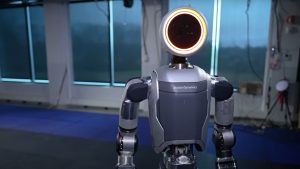
Figure AI’s Approach: Figure 03 and the Camera-First Philosophy
Figure 03’s Redesigned Sensory Suite
Figure AI’s third-generation robot, Figure 03, introduced what the company calls a fully redesigned sensory suite built around its Helix AI system. The headline upgrade is the camera architecture: double the frame rate, about a quarter of the latency, and a 60% wider field of view per camera compared to Figure 02, plus new palm-mounted cameras embedded in each hand. Those palm cameras matter because they keep Helix “looking” even when the main head cameras are blocked — for example, when the robot is reaching into a cabinet.
Does Figure 03 Use LiDAR?
Here’s where it gets genuinely interesting, and where I’d push back on a few “spec sheet” articles floating around online. Figure AI’s own announcements about Figure 03 focus almost entirely on cameras, depth-of-field, and tactile sensing — they don’t list LiDAR as a headline feature. At the same time, several independent robot-database and review sites (and at least one retail listing) describe Figure 03 as including a solid-state LiDAR unit alongside its depth cameras for navigation and obstacle avoidance. Treat that as an unconfirmed detail rather than an official spec: Figure’s public materials lean heavily camera-first, similar in spirit (though not in execution) to Tesla’s approach, while third-party listings suggest at least some configurations carry a supporting LiDAR module. If you’re writing about this for a technical audience, it’s worth flagging that ambiguity rather than stating it as settled fact.
Helix AI and Vision-Language-Action Models
What’s not in dispute is how central the camera-fed AI model is to Figure’s strategy. Helix is a vision-language-action (VLA) model — it takes in raw camera images and tactile feedback and outputs joint movements directly, without a traditional LiDAR-built map sitting in the middle. Figure’s “System 0” controller now conditions whole-body movement on camera-derived 3D scene understanding (built from stereo RGB, not LiDAR), which is how newer Figure 03 demos handle stairs, ramps, and uneven terrain that earlier versions couldn’t.
Tesla Optimus: Why It Skips LiDAR Entirely
Tesla’s Vision-Only Philosophy
Tesla Optimus relies primarily on cameras, drawing on neural networks descended from Tesla’s Full Self-Driving (FSD) stack, combined with force/torque sensors and IMUs for balance and contact awareness. There’s no LiDAR and no radar in the design — and that’s not an oversight, it’s policy. Tesla made the same call for its cars back in 2021, ripping out radar in favor of a camera-only system called Tesla Vision, and Optimus simply inherited that philosophy along with the underlying perception software.
Lessons from Tesla Vision in Cars
Elon Musk’s stated reasoning, repeated for both cars and robots, centers on what he calls “sensor contention”: when a camera and a LiDAR disagree about what’s in front of the vehicle (or robot), something has to decide which sensor to trust, and that decision-making process is itself a source of risk. Tesla’s bet is that if a neural network is trained on enough real-world camera data, it can match or beat LiDAR-based perception without the added cost, weight, and complexity of a second sensing modality.
Risks and Trade-offs of Going Camera-Only
I’ll be straightforward about where I land on this: the jury is still out, and it’s worth not picking a side dogmatically. Critics — including former Tesla engineers and outside robotics researchers — point out that LiDAR simply won’t fail to detect a large object directly ahead, even if it can’t classify what that object is, whereas a camera-only system can be fooled by glare, fog, low light, or a visually ambiguous scene. Camera-only also lowers cost and avoids the mechanical complexity of spinning or scanning hardware. For Optimus specifically, this trade-off is amplified by the fact that the robot is meant to eventually work in homes and warehouses — environments with far more lighting variability than a sealed factory cell. Tesla is leaning on scale: its Cortex training infrastructure and a dedicated AI6 chip (now earmarked specifically for Optimus and data centers rather than cars) are meant to brute-force good-enough vision-only perception through sheer training volume.
Other Humanoid Robots Using LiDAR in 2026
Boston Dynamics and Tesla represent the two extremes, but most of the rest of the humanoid robot field sits firmly in the LiDAR-plus-camera camp.
Agility Robotics’ Digit
Digit, the most commercially deployed humanoid robot as of 2026 (it’s been moving totes at Amazon, GXO Logistics, and as of a February 2026 deal, on a Toyota RAV4 assembly line in Ontario, Canada), uses LiDAR together with depth cameras for navigation, feeding into the cloud-based Agility Arc fleet management platform. Some industry comparison trackers report Digit’s LiDAR hardware is sourced off-the-shelf rather than built in-house, which is common for companies focused on rapid commercial deployment rather than full vertical integration.
Unitree’s G1 and H1
Chinese robotics company Unitree has built its reputation partly on affordability — the G1 starts at roughly $16,000, dramatically cheaper than most Western humanoids. Both the G1 and the faster H1 (which can walk at up to 3.3 meters per second) use 3D LiDAR paired with depth cameras for 360-degree perception, letting them navigate research labs and light industrial settings without needing a pre-mapped environment.
Apptronik’s Apollo
Apollo, built by an Austin, Texas team with roots in NASA’s Valkyrie robot program, is being piloted by Mercedes-Benz for parts delivery and tote handling. Several third-party spec databases list a 3D LiDAR and depth-camera combination as part of Apollo’s perception stack, though it’s worth noting Apptronik itself hasn’t published detailed sensor specs publicly — so, similar to Figure 03, treat the LiDAR claim as reported rather than officially confirmed.
Solid-State LiDAR: The Technology Powering 2026’s Humanoid Robots
Why Solid-State Beats Mechanical Spinning LiDAR
Older LiDAR units used a visibly spinning mechanical assembly — fine for a self-driving car with room on the roof, but bulky and fragile for a robot’s head or chest. 2026’s humanoid robot boom has been driven largely by the maturity of solid-state LiDAR, which uses prisms, MEMS mirrors, or fully digital SPAD-based sensors instead of moving parts. That means smaller packages, better shock resistance, and — crucially — automotive-grade reliability inherited from years of LiDAR development for self-driving cars.
Key LiDAR Suppliers: Hesai, RoboSense, and Livox
Three Chinese suppliers dominate this corner of the market. RoboSense, which became the world’s top LiDAR brand by shipment volume in 2024, reported shipping over 300,000 robotics-sector LiDAR units in 2025 alone — a jump of more than 1,100% year-over-year — and now counts Unitree and AgiBot among its humanoid robot partners. Hesai’s compact JT-series LiDAR, purpose-built for robotics rather than cars, passed 200,000 unit deliveries within a year of launch and is scaling toward 4 million units of annual production capacity in 2026. Livox, a DJI spinoff, supplies the widely used Mid-360 module found in many research and mid-market robot platforms. The rapid price drops these suppliers have driven — largely thanks to scale from the automotive ADAS market — are a big reason LiDAR has become affordable enough to put on a humanoid robot’s head in the first place.
Boston Dynamics LiDAR vs Tesla Vision: Comparison Table
| Robot | Uses LiDAR? | Primary Perception Stack | Target Environment | Approx. Price/Status (2026) |
|---|---|---|---|---|
| Boston Dynamics Atlas | Yes | LiDAR + stereo/RGB cameras + depth sensors | Auto manufacturing (Hyundai) | Production slots sold through 2026 |
| Tesla Optimus | No | Cameras only (FSD-derived vision) | Tesla factories, future homes | ~$20K–$30K target, not yet for sale |
| Figure 03 | Disputed/unclear | Stereo + palm cameras, tactile sensors (LiDAR reported by some third parties, not confirmed by Figure) | Homes, light commercial | ~$20K target, limited pilots |
| Agility Digit | Yes | LiDAR + depth cameras | Warehouses, logistics | $250K+, commercially deployed |
| Unitree G1 / H1 | Yes | 3D LiDAR + depth camera | Research, light industrial | $16K (G1) – $90K (H1) |
| Apptronik Apollo | Reported, unconfirmed | LiDAR + depth cameras (per third-party specs) | Logistics, manufacturing | Sub-$50K target, pilots ongoing |
Frequently Asked Questions
What is a LiDAR sensor?
A LiDAR sensor is a device that measures distance by firing laser pulses and timing how long they take to bounce back from nearby objects. It builds a precise 3D “point cloud” of the surrounding environment, which robots and self-driving cars use for navigation and obstacle detection.
Does Tesla Optimus use LiDAR?
Tesla Optimus uses a camera-only perception system derived from Tesla’s Full Self-Driving software, along with force/torque sensors and IMUs. Tesla deliberately avoids LiDAR and radar in both its cars and its humanoid robot, following the same vision-only philosophy across both product lines.
Does Figure 03 have a LiDAR sensor?
It’s not entirely clear. Figure AI’s own announcements for Figure 03 emphasize an upgraded camera and tactile sensing system without listing LiDAR as a core feature, while some independent spec sheets and retail listings mention a solid-state LiDAR unit. Until Figure AI confirms it directly, this should be treated as unverified.
Why does Boston Dynamics use LiDAR while Tesla doesn’t?
The two companies are solving different problems with different risk tolerances. Atlas works in heavy industrial settings where misjudging a distance could be dangerous or costly, so Boston Dynamics adds LiDAR for redundancy. Tesla is betting that camera-only AI, trained on enormous amounts of real-world data, can eventually match LiDAR’s reliability at lower cost and complexity.
Which humanoid robots use LiDAR in 2026?
Boston Dynamics’ Atlas, Agility Robotics’ Digit, Unitree’s G1 and H1, and (per some third-party reports) Apptronik’s Apollo all use LiDAR alongside cameras. Tesla Optimus is the most prominent humanoid robot that does not use LiDAR at all.
Conclusion
So, do humanoid robots need LiDAR? Based on everything happening in 2026, the honest answer is: it depends on what the robot has to do and how much risk its maker is willing to accept. Boston Dynamics, Agility, Unitree, and most of the rest of the industry are treating humanoid robots LiDAR integration as a safety and reliability layer that’s hard to justify removing, especially once robots start working unguarded next to humans on a factory floor.
Tesla is the outlier, betting that vision-only AI will eventually close the gap the same way it’s trying to in cars. Figure AI sits somewhere in between, leaning hard into cameras while leaving some ambiguity about whether LiDAR is quietly along for the ride. Whichever side wins this argument, the falling cost of solid-state LiDAR from suppliers like Hesai, RoboSense, and Livox means the hardware itself is no longer the bottleneck — the real race in 2026 is about whose AI model can make the best use of whatever sensors it’s given.

Technology writer and researcher passionate about LiDAR, robotics, and AI systems. Through Lidarmos, I share in-depth guides and insights to make cutting-edge sensing technology accessible to everyone.

