
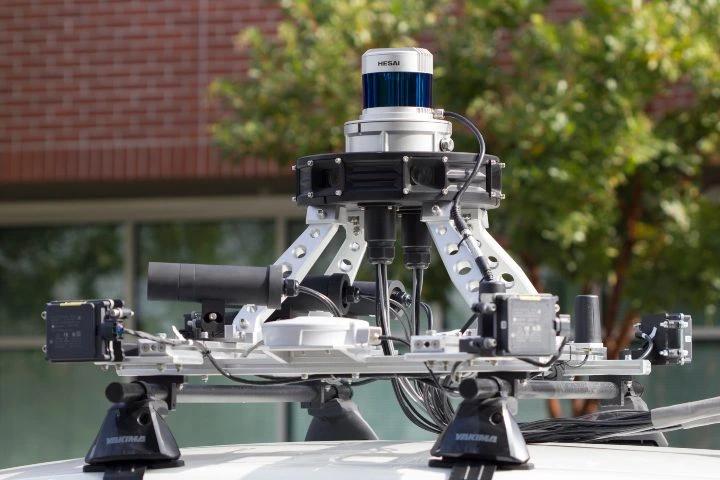
Have you ever wondered how a self-driving car “sees” the road, or how your phone can map a room in seconds? The answer often involves a sensor called LiDAR, working together with artificial intelligence. On its own, LiDAR is like a super-accurate measuring tool that bounces laser light off objects to figure out how far away they are. But raw LiDAR data is messy and huge — too much for humans to sort through quickly. That’s where AI LiDAR systems come in. By adding machine learning LiDAR models on top of the raw sensor data, machines can now recognize cars, people, trees, and buildings almost instantly. In this article, I’ll walk you through how this combination works, why it matters, and where you’ll see it being used in everyday life.
What Is LiDAR and Why Does It Need AI?
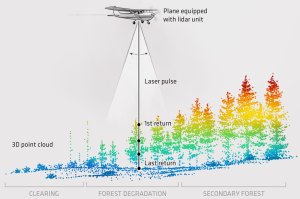
LiDAR stands for Light Detection and Ranging. It works by sending out thousands of laser pulses every second and measuring how long they take to bounce back. From this, a device builds a 3D map of the world called a “point cloud.” Each point in this cloud represents a tiny piece of a real object, like the edge of a car bumper or a tree branch.
The problem is that a single LiDAR sensor can generate millions of points every second. A human could never look at this raw data and make sense of it fast enough to, say, stop a car before it hits a pedestrian. This is exactly the gap that machine learning LiDAR software fills.
Related Article: What is LiDAR? A Simple Beginner’s Guide (2026)
The Raw Data Problem
Point clouds by themselves don’t label anything. The sensor doesn’t know if a cluster of points is a parked bicycle or a fire hydrant. It’s just dots in space. Without further processing, this data is not very useful for real-time decisions.
Why Rule-Based Software Falls Short
Early LiDAR systems tried to use fixed rules, like “if a cluster of points is this tall and this wide, it’s probably a person.” In my experience reading about these older systems, this approach broke down constantly. A short adult, a tall child, and a mailbox could all confuse a rules-based system, because real-world objects don’t follow neat size categories.
How AI Changes the Game
AI models, especially deep learning networks, learn patterns from thousands of labeled examples instead of following fixed rules. This means an AI LiDAR system can tell the difference between a cyclist and a parked motorcycle even in tricky lighting or weather, because it has effectively “seen” similar examples before during training.
How Machine Learning Improves LiDAR Sensors
Machine learning doesn’t just help interpret LiDAR data after it’s collected — it can improve the sensor’s performance at almost every stage, from filtering noise to predicting what will happen next.
Noise Filtering and Cleanup
Rain, fog, dust, and even bright sunlight can create false readings in raw LiDAR data, called noise. Machine learning models are trained to recognize the difference between real objects and these false signals, which makes the sensor far more reliable in bad weather.
Object Detection and Classification
This is probably the most well-known use of machine learning LiDAR technology. A trained model scans the point cloud and draws boxes around objects, labeling each one as a car, pedestrian, cyclist, or something else. The interesting thing about LiDAR object detection is that it can do this even in complete darkness, since lasers don’t need ambient light the way cameras do.
Predicting Movement
Beyond just labeling what’s there right now, newer AI LiDAR systems try to predict where an object will be a second or two later. This is critical for self-driving cars, since the vehicle needs to know not just where a pedestrian is standing, but where they’re about to step.
Real-World Applications of AI LiDAR
AI-powered LiDAR isn’t just for self-driving cars. It’s quietly working behind the scenes in several industries you might not expect.
Self-Driving Cars and Advanced Driver Assistance
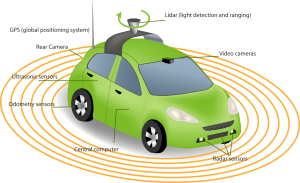
Autonomous vehicles rely on LiDAR to build a 3D understanding of their surroundings, then use AI to decide how to react. If you want a deeper technical comparison of how this stacks up against other sensors, check out our article on LiDAR vs Radar: Which Sensor Wins for Self-Driving Cars for a closer look.
Robotics and Warehouse Automation
Warehouse robots use AI LiDAR to navigate around shelves, workers, and other robots without colliding. For a beginner-friendly breakdown of the sensing process itself, see our guide on How LiDAR Works: A Beginner’s Guide.
Related Article: How Humanoid Robots Use LiDAR: Boston Dynamics, Figure AI & More
Smart Cities, Drones, and Mapping
Drones equipped with LiDAR and AI can quickly map construction sites, forests, or disaster zones. Cities are also experimenting with LiDAR-based traffic monitoring to reduce congestion. If you’re new to the basics, our article What Is LiDAR? A Simple Introduction is a good starting point.
The Technology Behind AI-Powered LiDAR
Understanding a bit about what’s happening “under the hood” helps explain why AI LiDAR systems are improving so quickly.
Neural Networks Built for 3D Data
Most modern systems use a type of neural network specifically designed for point clouds, since regular image-recognition networks aren’t built to handle scattered 3D points. These specialized networks can find patterns in the shape and density of points to recognize objects.
Sensor Fusion with Cameras and Radar
Many systems don’t rely on LiDAR alone. AI models often combine, or “fuse,” LiDAR data with camera images and radar signals. I found that this combination tends to be more reliable than any single sensor, because each one covers the others’ weaknesses. Cameras read text and colors, radar handles speed and bad weather, and LiDAR provides precise distance and shape information.
Edge Computing for Real-Time Decisions
Self-driving cars and drones can’t wait for data to travel to a distant server and back. AI LiDAR processing increasingly happens on small, powerful chips built directly into the vehicle or device, known as edge computing, so decisions happen in milliseconds.
Benefits of Combining AI and LiDAR
Pairing machine learning with LiDAR sensors brings several clear advantages over using either technology alone.
Faster and More Accurate Object Recognition
AI models can sort through millions of data points and identify objects far faster than manual or rule-based methods, often in real time.
Better Performance in Difficult Conditions
Trained models can adapt to fog, rain, dust, and low light far better than older systems, since they’ve learned from many examples of these tricky conditions.
Lower Costs Over Time
As AI models get better at filtering noise and detecting objects accurately, manufacturers can sometimes use simpler, cheaper LiDAR hardware while still getting reliable results, since the software is doing more of the heavy lifting.
Challenges and Limitations of AI LiDAR
It’s not all smooth sailing. AI LiDAR technology still faces real hurdles that engineers are actively working to solve.
Data and Training Requirements
Machine learning models need huge amounts of labeled LiDAR data to train properly. Collecting and labeling this data is expensive and time-consuming, and mistakes in labeling can teach the model the wrong lessons.
Computing Power and Energy Use
Running complex AI models in real time requires a lot of computing power, which can drain battery life in drones or add cost and heat in vehicles. Engineers are constantly working on making these models more efficient.
Edge Cases and Unpredictable Situations
AI models are only as good as the situations they’ve been trained on. A rare event, like a couch falling off a truck onto the highway, might confuse a model that has never seen anything like it before. This is one of the main reasons fully self-driving cars are still being carefully tested rather than rolled out everywhere at once.
Traditional LiDAR vs AI-Powered LiDAR
Here’s a simple side-by-side comparison to show how machine learning changes what a LiDAR sensor can actually do.
| Feature | Traditional LiDAR | AI-Powered LiDAR |
| Object Recognition | Limited, rule-based, often inaccurate | Learns patterns, highly accurate |
| Performance in Bad Weather | Struggles with rain, fog, dust | Filters noise and adapts better |
| Processing Speed | Slower manual analysis | Real-time decisions in milliseconds |
| Prediction Ability | Cannot predict future movement | Predicts likely paths of objects |
| Hardware Cost Over Time | Often needs higher-end sensors | Can use simpler sensors with smart software |
| Setup Complexity | Simpler to deploy, less flexible | Needs training data, more flexible long-term |
Frequently Asked Questions About AI LiDAR
Q: What is a LiDAR sensor?
A: A LiDAR sensor is a device that uses laser light to measure distances to nearby objects. It sends out laser pulses and calculates how long they take to bounce back, building a detailed 3D map of the surrounding area.
Q: How does AI improve LiDAR data?
A: AI improves LiDAR data by automatically sorting through millions of data points, filtering out noise, and identifying objects like cars, people, and obstacles. This process, often called machine learning LiDAR analysis, is far faster and more accurate than manual or rule-based methods.
Q: Is AI LiDAR only used in self-driving cars?
A: No, AI LiDAR is used in many other fields too, including warehouse robots, drones for mapping, agricultural equipment, and smart city traffic systems. Self-driving cars are just the most widely discussed example.
Q: Can LiDAR work in bad weather?
A: Traditional LiDAR can struggle in heavy rain, fog, or dust because these conditions create false readings. AI-powered LiDAR systems are trained to recognize and filter out this kind of noise, which makes them noticeably more reliable in difficult weather.
Q: Is AI LiDAR expensive to use?
A: LiDAR hardware can be costly, though prices have been dropping steadily. The good news is that smarter AI software can sometimes make up for using simpler, cheaper sensors, since the machine learning model handles more of the difficult interpretation work.
Conclusion
AI and LiDAR make a powerful team. On its own, LiDAR gives machines incredibly precise distance and shape information, but it takes machine learning LiDAR models to turn that raw data into real understanding — recognizing a pedestrian, predicting a cyclist’s next move, or filtering out fog. This combination is already shaping self-driving cars, warehouse robots, drones, and even how cities manage traffic. There are still real challenges, from the cost of training data to handling rare, unpredictable situations. But based on how quickly this field is moving, I expect AI LiDAR systems to keep getting smarter, cheaper, and more common in the years ahead. Whether you’re curious about the technology or considering a career in robotics or autonomous vehicles, understanding how AI and LiDAR work together is a great place to start.

Technology writer and researcher passionate about LiDAR, robotics, and AI systems. Through Lidarmos, I share in-depth guides and insights to make cutting-edge sensing technology accessible to everyone.

