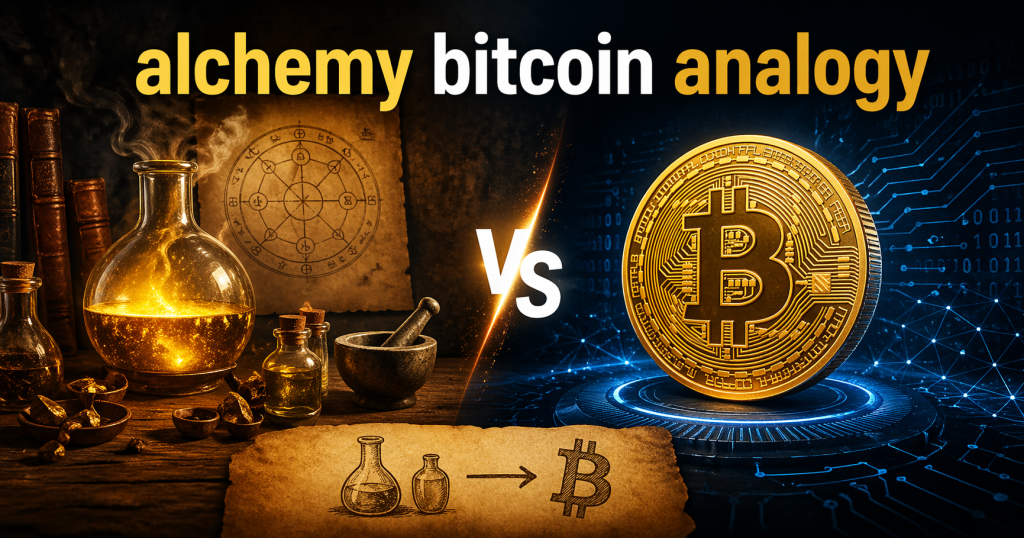
The idea of an alchemy bitcoin analogy might sound strange at first, but when you think about it, the comparison starts to make sense. Long ago, alchemists tried to turn ordinary metals into gold. Today, many people look at Bitcoin and feel like it’s doing something similar, turning invisible digital code into something valuable. That’s why the comparison keeps coming up.
But is Bitcoin really like alchemy? Or is it something more real and grounded?
Some people believe Bitcoin is just hype, like an old dream that never worked. Others believe it’s one of the most important financial inventions of our time. This article will help you understand both sides in a simple way, so you can decide for yourself.
What Was Alchemy? A Simple Breakdown
Alchemy was an old practice that goes back hundreds of years. People who practiced it were called alchemists. Their main goal was simple: they wanted to turn cheap metals like lead into gold.
That idea attracted many people because gold has always been valuable. If someone could create gold from something cheap, they could become very rich. So alchemists spent years trying different methods, mixing chemicals, heating metals, and following strange processes.
But there was one big problem.
Alchemy was not based on real science. It was built on guesswork, belief, and trial and error. Even though some alchemists made small discoveries that later helped science grow, the main goal of turning metal into gold never worked.
In the end, alchemy became known as a failed idea. It promised something amazing but could not deliver it in reality.
What Is Bitcoin, in Plain English?
Now let’s talk about Bitcoin.
Bitcoin is a type of digital money. You can’t touch it or hold it like cash. It exists only online. But people can send it, receive it, and store it just like money.
One of the most important things about Bitcoin is that no bank or government controls it. Instead, it runs on a system called blockchain. This system records every transaction in a public and secure way.
Another important point is that Bitcoin has a limited supply. There will only ever be 21 million Bitcoins. This limit makes it rare, and rarity often creates value.
People can also “mine” Bitcoin. This doesn’t mean digging in the ground. It means using computers to solve complex problems. When those problems are solved, new Bitcoin is created.
So in simple terms, Bitcoin is:
- Digital
- Limited
- Decentralized
- Created through technology
The Core Analogy: Bitcoin vs Alchemy
Now let’s connect both ideas.
Alchemy tried to turn something ordinary into something valuable. Bitcoin seems to do something similar, at least on the surface. It takes digital data, something you cannot see or touch, and turns it into something people are willing to pay real money for.
Here’s how the comparison works:
Alchemists worked with base metals. In the modern world, Bitcoin starts with digital code. Alchemists wanted gold. Bitcoin users want value, profit, or a store of wealth.
Both involve a kind of transformation. In alchemy, the transformation was physical. In Bitcoin, the transformation is digital and economic.
Also, both are hard to understand for beginners. If you explain alchemy or Bitcoin to someone with no background, they might feel confused. That confusion often leads to doubt.
This is why people make the comparison. It’s not because they are exactly the same, but because they feel similar at a basic level.
Why the Comparison Feels So Convincing
There are a few reasons why people find this analogy believable.
First, both ideas sound almost magical. Turning metal into gold sounds impossible. Turning digital code into money also sounds strange, especially to someone new.
Second, both attract strong believers. Alchemists truly believed they would succeed. In the same way, many Bitcoin supporters strongly believe in its future.
Third, both face criticism. In the past, people laughed at alchemists. Today, some people laugh at Bitcoin and call it a bubble or a scam.
Fourth, both involve complexity. The average person does not understand chemistry deeply, and they also may not understand blockchain or cryptography. When something is hard to understand, people often compare it to something mysterious.
All of these reasons make the comparison feel real, even if it’s not fully accurate.
Where the Analogy Breaks Down
Even though the comparison is interesting, it is not perfect. In fact, this is where things become clearer.
Alchemy failed because it had no scientific base. It relied on beliefs that were not true. No matter how much effort people put in, they could not turn lead into gold.
Bitcoin is different.
Bitcoin is built on mathematics, computer science, and cryptography. These are real and tested fields. The system works exactly as designed. Transactions happen, records are stored, and the network continues to run.
Another key difference is transparency. Alchemy was secretive. Many alchemists hid their methods. Bitcoin, on the other hand, is open. Anyone can study how it works. The code is available, and the system is public.
Also, Bitcoin is already being used. People buy, sell, invest, and even accept Bitcoin as payment. Alchemy never reached that stage.
So while the analogy is helpful for understanding, it does not mean Bitcoin is fake or useless.
Why Bitcoin Is Called “Digital Gold”
Many people call Bitcoin “digital gold,” and this idea connects strongly to the alchemy comparison.
Gold is valuable because it is rare, durable, and widely accepted. Bitcoin shares some of these qualities.
First, Bitcoin is scarce. There is a fixed limit of 21 million coins. This makes it similar to gold, which is also limited in supply.
Second, Bitcoin can be stored and transferred easily. You don’t need to carry physical weight. You can send it across the world in minutes.
Third, people trust it. As more people use Bitcoin, its value grows. This is similar to how gold became valuable over time because people agreed it had value.
The mining process also adds to the comparison. Just like gold mining requires effort and resources, Bitcoin mining requires powerful computers and energy.
This is why many people see Bitcoin not as alchemy, but as a modern form of gold.
The Psychology Behind the Comparison
Human thinking plays a big role in this comparison.
People often fear new ideas. When something is unfamiliar, it feels risky. Bitcoin is still new compared to traditional money, so many people don’t trust it.
Another reason is that people like simple explanations. The alchemy analogy is simple. It helps people quickly form an opinion, even if that opinion is not fully accurate.
There is also a history of doubt with new systems. When paper money was first introduced, many people did not trust it. Later, when the internet started, people doubted its usefulness.
Over time, these ideas became normal.
Bitcoin may be going through the same phase. What seems strange today might feel normal in the future.
Is Bitcoin Truly Valuable or Just Hype?
This is one of the most important questions.
Bitcoin gets its value from supply and demand. Since the supply is limited, the price can rise if more people want it.
It also gains value from trust. If people believe Bitcoin is useful and reliable, they will continue to use it. That increases its demand.
Another factor is adoption. More companies, investors, and even institutions are getting involved with Bitcoin. This adds to its credibility.
However, it is also true that Bitcoin can be volatile. Its price goes up and down quickly. This makes it risky, especially for beginners.
So is it hype?
The honest answer is: it’s a mix. Bitcoin has real technology and real use cases, but it also has hype around it. The key is to understand both sides before making decisions.
Final Thoughts
The comparison between Bitcoin and alchemy is interesting and useful, but it should not be taken too far.
Alchemy was based on hope without proof. Bitcoin is based on technology that works. While both involve transformation, the nature of that transformation is very different.
Bitcoin is not magic. It does not create value out of nothing. Its value comes from trust, scarcity, and the system behind it.
At the same time, it is still evolving. It may grow stronger, or it may face challenges. Like any innovation, its future is not fully certain.
The best approach is to stay informed, think clearly, and avoid extreme views. Don’t treat it like magic, but don’t dismiss it without understanding it either.
Read more Interesting and informational Blogs Visit Our Website Lidarmos
Frequently-Asked Questions (FAQs)
Is Bitcoin backed by anything?
Bitcoin is not backed by a physical asset like gold. Its value comes from trust, demand, and the technology behind it.
Why do people compare Bitcoin to alchemy?
Because both involve turning something ordinary into something valuable. However, Bitcoin is based on real technology, unlike alchemy.
Is Bitcoin safe to use?
Bitcoin itself is secure, but users need to be careful. Risks usually come from scams, poor storage, or lack of knowledge.
What gives Bitcoin its value?
Its limited supply, growing demand, and increasing adoption all contribute to its value.
Is Bitcoin a good investment?
It can be, but it also carries risk. Prices can change quickly, so it’s important to research and be cautious.

Technology writer and researcher passionate about LiDAR, robotics, and AI systems. Through Lidarmos, I share in-depth guides and insights to make cutting-edge sensing technology accessible to everyone.