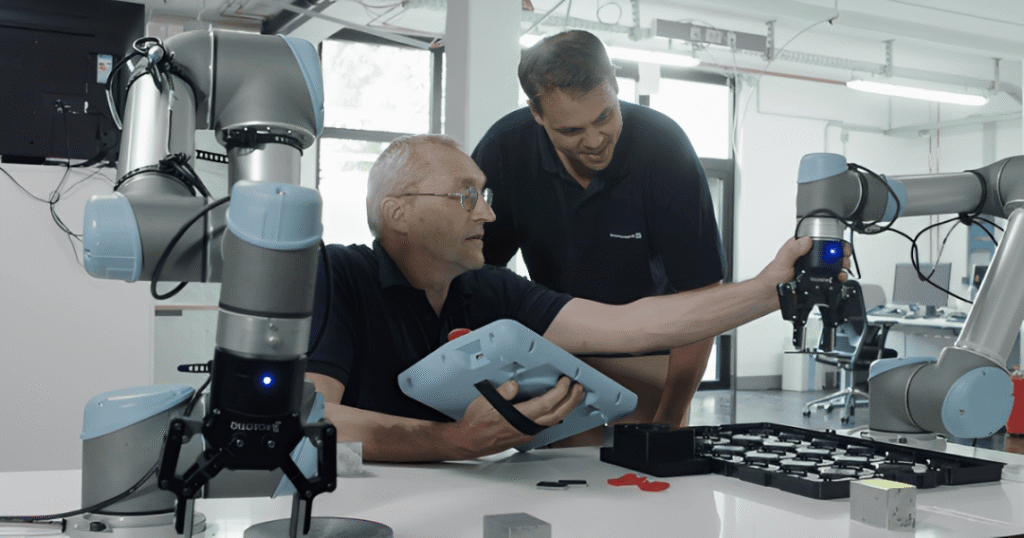
Autonomous technology is no longer experimental. Self-driving cars carry passengers through city streets, delivery and military drones fly routine missions, and quadruped and humanoid robots patrol warehouses, construction sites, and even office lobbies. These machines depend on a dense web of sensors, wireless links, and onboard software to understand the world and act on it safely.
That dependence is exactly what makes them attractive targets. Every sensor that lets a robot “see” is also a channel an attacker can try to manipulate. Every wireless link that lets a drone receive commands is also a door that, if left unlocked, lets someone else send commands instead. As autonomous systems move from labs into streets, warehouses, and battlefields, securing them has become one of the most urgent and least understood areas of cybersecurity.
This article looks at why autonomous systems are such a tempting target, the main ways they get attacked, how leading companies are responding, and what good security practice looks like for organizations building or deploying robotics and LiDAR-based systems.
Why Autonomous Systems Are a Cybersecurity Target
Traditional IT security focuses on protecting data: stealing it, corrupting it, or holding it for ransom. Autonomous systems raise the stakes considerably, because the “data” in question is directly tied to physical movement. A compromised laptop leaks information. A compromised delivery robot, drone, or self-driving car can crash, collide with a person, or be redirected entirely.
Several factors make autonomous systems especially exposed:
- They fuse multiple sensors in real time. Cameras, radar, LiDAR, GPS, and inertial measurement units all feed a perception system that has to make split-second decisions. Attackers don’t need to compromise the whole stack — fooling just one sensor can be enough to trigger an unsafe maneuver.
- They are built from layers of third-party software. Many robotics platforms run on shared frameworks such as ROS (Robot Operating System), open-source libraries, and off-the-shelf components. A flaw in one widely used library can affect thousands of deployed machines at once.
- They communicate wirelessly. Drones take commands over radio links, self-driving cars talk to cloud fleets over cellular networks, and warehouse robots connect to local Wi-Fi and Bluetooth. Every wireless connection is a potential entry point.
- They operate in physically accessible, sometimes adversarial, environments. Unlike a server in a locked data center, a drone flies over open terrain and a delivery robot rolls down a public sidewalk — both within range of anyone with the right equipment.
- The consequences are physical, not just financial. A breached e-commerce account costs money. A breached autonomous vehicle or industrial robot can cost lives.
This combination — complex software, wireless exposure, physical access, and high-stakes consequences — is why security researchers increasingly treat autonomous systems as critical infrastructure rather than ordinary consumer electronics.
Common Attack Vectors: GPS Spoofing, Sensor Jamming, and Data Breaches
GPS Spoofing
GPS spoofing involves broadcasting fake satellite navigation signals that overpower the real ones, tricking a receiver into calculating the wrong position, time, or both. For a drone or autonomous vehicle that relies on GPS for navigation, a successful spoof can quietly redirect it far from its intended path or cause it to behave erratically.
This is not a theoretical risk. Aviation monitoring group Ops Group found that during the summer of 2024, an average of roughly 1,500 commercial flights a day experienced GPS spoofing disruption, a fivefold increase compared with the prior year — and the same electronic warfare techniques being used in conflict zones to disrupt aircraft are also being used against drones. Ukraine has developed GPS spoofing capabilities specifically to hijack incoming attack drones, including Iranian-designed Shahed models, manipulating their navigation signals to divert them off course or cause them to crash before reaching their targets.
The effects aren’t always contained to military hardware. In late 2024, Ukrainian electronic warfare systems used to spoof GPS signals against drones also disrupted civilian smartphones nearby, causing some phones to display the wrong location or time zone — a reminder that GPS spoofing aimed at one target can ripple outward into everyday consumer devices.
Sensor Jamming and LiDAR Spoofing
LiDAR (Light Detection and Ranging) is one of the primary sensing technologies used by autonomous vehicles to build a 3D map of their surroundings. It is the preferred navigation and sensing technology in robotic taxis from Waymo and Cruise, and an important component in consumer vehicles from Volvo, Mercedes-Benz, and Huawei.
Researchers have repeatedly shown that LiDAR can be fooled. A team from the University of California, Irvine and Japan’s Keio University tested nine commercially available LiDAR systems and demonstrated how lasers could be used to make LiDAR “see” objects that aren’t there, or fail to see objects that are. One technique, called fake object injection, tricks the sensor into perceiving a pedestrian or another vehicle in the road, which causes the LiDAR system to report a false hazard and can trigger unsafe behavior such as emergency braking. A co-author of the study noted that the attacks can also make real vehicles or pedestrians effectively disappear from the car’s view, which can lead to dangerous outcomes including sudden braking or collisions.
LiDAR isn’t only vulnerable to lasers. A separate line of research out of Waseda University showed that artificially generated fog can be used to trick LiDAR sensors in self-driving cars by exploiting how point-cloud preprocessing filters remove “noise,” causing real obstacles like pedestrians or other cars to be erased from the sensor data. In other words, an attacker doesn’t necessarily need a laser rig — something as simple as a smoke machine, deployed with knowledge of the filtering algorithm, can blind a vehicle to a real hazard.
Drones face a related but distinct threat: sensor and signal jamming. Beyond GPS, researchers have also demonstrated attacks that target a drone’s gyroscopic sensors using intentional acoustic noise, destabilizing flight control without ever touching the vehicle’s code.
Data Breaches and Network Intrusion
Autonomous systems don’t operate in isolation — they’re connected to fleet management platforms, cloud backends, and often the broader internet. That connectivity creates traditional cybersecurity exposure layered on top of the physical risks.
Quadruped and humanoid robots illustrate this well. Security researchers comparing commercial platforms found wide variation in how seriously manufacturers take this risk. Boston Dynamics’ Spot is widely treated as a security benchmark, using TLS 1.2+ encrypted communications, mutual authentication via X.509 client certificates, cryptographically signed firmware integrity checks, and per-device unique encryption keys. By contrast, competing quadruped platforms from Unitree have shown serious fleet-wide flaws — a 2025 disclosure known as “UniPwn” revealed that Unitree robots used a hardcoded encryption key for setting up Bluetooth connections, a weakness that could potentially be exploited across an entire product line at once rather than one robot at a time.
Threat intelligence researchers tracking the robotics sector have also observed sustained malicious activity. Since late 2024, security teams have identified multiple campaigns involving remote access trojans such as Dark Crystal RAT and AsyncRAT targeting robotics-adjacent networks, alongside other malware families including XWorm and the Havoc framework — with researchers warning that attackers may also be positioning themselves inside hardware and software supply chains rather than attacking deployed robots directly.
Consumer-facing robots aren’t exempt either. At DEF CON 32, researchers presented findings on hacking Ecovacs robot vacuums, demonstrating how household robots with cameras and microphones can become surveillance tools if their software isn’t properly secured.
How Companies Like Waymo and Boston Dynamics Secure Their Systems
The gap between well-secured and poorly-secured autonomous platforms is large, and it largely comes down to engineering discipline applied early in the design process rather than bolted on afterward.
Defense-in-depth sensor fusion. Rather than trusting a single sensor, well-designed autonomous vehicles cross-check GPS, LiDAR, radar, cameras, and inertial measurement data against each other. If one sensor reports something the others don’t corroborate, the system can flag a possible spoofing or jamming event instead of blindly acting on bad data. Newer-generation LiDAR units have also moved toward timing randomization and pulse fingerprinting specifically to defeat the kind of fake-object injection attacks researchers demonstrated against first-generation sensors.
Strong authentication and encrypted communications. As the Boston Dynamics example shows, encrypting every command channel, authenticating both ends of a connection with certificates rather than static passwords, and giving each individual robot its own unique cryptographic keys all sharply raise the cost of a remote attack. A hardcoded key shared across an entire product line, by contrast, means that breaking one device can mean breaking all of them.
Signed and verified firmware. Cryptographically signed firmware and hash-tree integrity checks make it much harder for an attacker — or a compromised supply chain — to slip malicious code into a robot’s update process undetected.
Responsible disclosure programs. Boston Dynamics, like many serious robotics manufacturers, runs a formal vulnerability disclosure program inviting outside security researchers to report flaws responsibly so they can be patched before being exploited.
Anomaly detection at the fleet level. Companies operating large fleets of autonomous vehicles or robots increasingly monitor for unusual patterns across the whole fleet — a vehicle reporting a position inconsistent with its known route, or a robot suddenly transmitting abnormal volumes of data — as an early warning system for compromise.
No company has solved this problem completely. Researchers have shown that LiDAR spoofing techniques can be adapted to defeat even newer-generation sensors with enough engineering effort, and the industry broadly acknowledges that adversarial attacks on perception systems contributed to high-profile safety incidents and recalls at both Waymo and Cruise. Security in this space is best understood as an ongoing arms race rather than a finished achievement.
Best Practices for Securing LiDAR and Robotics Networks
For organizations building, deploying, or operating autonomous systems, several practices consistently separate resilient deployments from vulnerable ones:
- Treat every sensor input as untrusted until verified. Cross-check GPS against inertial navigation, and LiDAR against camera and radar data, rather than letting any single sensor make safety-critical decisions alone.
- Encrypt and authenticate every wireless link. Command-and-control channels for drones and robots should use strong encryption and certificate-based authentication rather than static passwords or unauthenticated radio links.
- Avoid hardcoded credentials and shared secrets across a product line. Each device should have unique keys, so that compromising one unit doesn’t compromise an entire fleet.
- Patch and update systematically. Robotics platforms often run on shared open-source frameworks; a vulnerability in one widely used component can affect many products at once, so update pipelines need to be fast and reliable.
- Monitor for jamming and spoofing in real time. Dedicated GNSS spoofing detection — comparing magnetometer heading data against GPS heading, or watching for sudden, physically implausible position jumps — can flag an attack before it causes a crash or hijack.
- Run a vulnerability disclosure or bug bounty program. Inviting outside researchers to find and report flaws responsibly, before malicious actors do, has become standard practice among security-mature robotics companies.
- Audit the supply chain, not just the finished product. With threat actors reportedly probing robotics supply chains directly, security reviews need to extend to component vendors and software dependencies, not just the assembled robot or vehicle.
- Plan for physical-world fallback behavior. Because these are physical machines, security design has to include a safe failure mode — what the drone or vehicle does when it detects it may be under attack — not just intrusion prevention.
Looking Ahead
Autonomous systems are moving from controlled pilot programs into everyday public use, and the security research keeps pace with that expansion. GPS spoofing that began as a wartime electronic warfare tactic now disrupts thousands of civilian flights a year. Academic LiDAR research that once lived in conference papers now directly informs how robotaxi companies harden their sensors. And the wide security gap between manufacturers like Boston Dynamics and less mature competitors shows that this is fundamentally an engineering and governance problem, not just a technical curiosity.
As more autonomous vehicles, drones, and robots take on real-world responsibilities — delivering packages, transporting passengers, patrolling facilities — the organizations that treat sensor security, encrypted communications, and supply-chain integrity as core requirements, rather than afterthoughts, will be the ones whose systems stay trustworthy as the technology scales.
Frequently Asked Questions
What is GPS spoofing, and why does it matter for drones and autonomous vehicles?
GPS spoofing broadcasts fake satellite signals to trick a receiver into reporting the wrong location or time. For drones and self-driving vehicles that rely on GPS for navigation, this can mean being steered off course or, in some documented cases, caused to crash.
Can LiDAR sensors really be hacked?
Yes. Researchers have demonstrated multiple ways to deceive LiDAR, including laser-based “fake object injection” that makes a sensor see objects that aren’t there, and fog-based attacks that erase real obstacles from the sensor’s data.
Are commercial robots like Boston Dynamics’ Spot secure?
Security varies significantly by manufacturer. Spot is generally regarded as a strong example, using encrypted communications, certificate-based authentication, and unique per-device keys. Other platforms in the same product category have had serious, fleet-wide vulnerabilities.
What’s the biggest difference between securing autonomous systems and securing regular IT systems?
Autonomous systems translate digital compromise into physical consequences. A hacked autonomous vehicle, drone, or industrial robot can cause real-world collisions or injuries, not just data loss — which is why sensor integrity and fail-safe behavior matter as much as traditional network security.
What can organizations do to reduce these risks?
Cross-checking sensor data, encrypting and authenticating every wireless command channel, avoiding shared or hardcoded credentials across a fleet, monitoring for spoofing and jamming in real time, and running a responsible vulnerability disclosure program are all practices that meaningfully reduce exposure.
Read more interesting and informational blogs — visit our website, Lidarmos.net.

Technology writer and researcher passionate about LiDAR, robotics, and AI systems. Through Lidarmos, I share in-depth guides and insights to make cutting-edge sensing technology accessible to everyone.